A cognitive system is one that performs the cognitive work of knowing, understanding, planning, deciding, problem solving, analyzing, synthesizing, assessing, and judging as they are fully integrated with perceiving and acting. It is a distributed system in which people with diverse roles and capabilities, and with the assistance of technological capabilities, collaborate in the planning and performance of cognitive work.
The figure to the left depicts the commercial airspace as a cognitive system: pilots, controllers, dispatchers and numerous others play out their specific roles in this complex, widely distributed and technologically intensive system that has the daily goal of transporting thousands of air travellers, each with a unique schedule, to their destinations safely and on time.
A cognitive system is a thinking (or intelligent) information system. However, the enhanced intelligence is not generated by the activity of intelligent technological functions as many in the discipline of Artificial Intelligence will want to claim, but emerges from the coordinated collaboration of distributed human agents via their interactions with each other and with functionally heterogeneous technological artifacts.
In the sense that collaborations between human agents and their use of technological artifacts are coordinated, effective, robust, and meaningful, the cognitive system is intelligent.
It is sometimes argued that computer-based agents can be employed to reason about the beliefs of human participants in teams. From the perspective I promote here, people reason but technological devices do not. Two people in coordination can possibly reason more effectively than either in isolation, and if they (as a coordinated dyad) avail themselves of the opportunities presented by technological devices that can compute logical relationships, find and organize information, and probably offer a number of as yet unimagined supporting functions, these entities (the two people together with their technological devices) constitute a reasoning system.
The design of a cognitive system requires a special set of analysis and design tools and, on this site, I describe the fundamentals. I rely on the framework of Cognitive Work Analysis and the strategy of Functional (Ecological) Workspace Design. The tutorials available on this site offer a guide.
I have developed an extensive set of workshops on analysis and design of cognitive systems. Contact me if you would like to host a workshop on this topic.
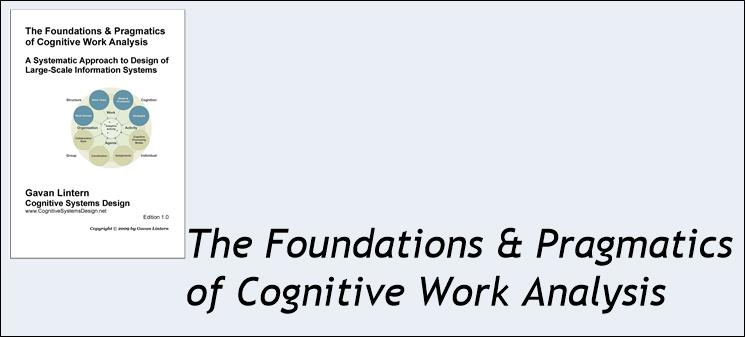
I am currently assembling workshop material, tutorials and published papers into a book which will be available from this site as a free download in June 2008.
As of 7 September 2007, you need to register to gain full access to this site.
To register, click the "Register" link above.
By registering, you will also receive advisories of site updates and additions along with site access.
You may request that you be deleted from the mailing list but your log in credentials will remain valid unless you request that they also be deleted.
I am currently testing a web conferencing system and, pending a successful test, will implement that soon. I will then organise a conference schedule. You should stay on the email list if you want to be updated on that schedule. This is a temporary link to the conference room. [All OSs supported for conference attendence]
If you want to take a turn as presenter, you need to install some software, which you can download after you enter the conference room. Click on the Help question mark near the center-top of the page to get a drop-Down menu that has a link to the download page.